

Don't Lead With a Demo: What Investors Actually Look for in First Meetings
Founders often walk into their first investor meeting eager to show a live product demo. The instinct is understandable: the product represents months or years of hard work. Yet in early investor conversations, leading with a demo is rarely the most effective strategy.
Top startup investors think about investing very differently than founders do. As Y Combinator co-founder Paul Graham has explained, “investors think of [startups] as markets, not just ideas.” In other words, founders think of startups as ideas, but investors think of them as markets, which means they care far more about validation of demand than a polished walkthrough.
This distinction matters more than most founders realize.
Why Traction Beats the Demo
Industry data shows that lack of market need is consistently the leading cause of startup failure.
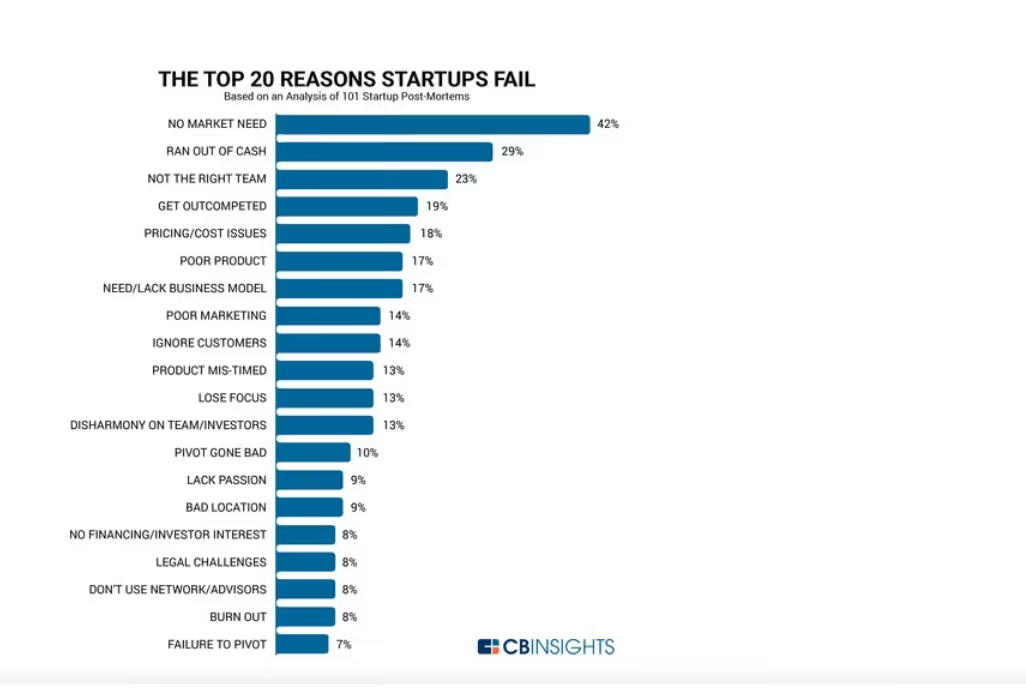
Yet founders still spend disproportionate time explaining features, interfaces, and product mechanics. From an investor’s perspective, the central question is simpler and more consequential: Will customers care enough to adopt, pay, and stick around?
Marc Andreessen captured this dynamic succinctly: “In a great market—a market with lots of real potential customers—the market pulls product out of the startup.” Traction, in other words, is not a byproduct of a great demo. It’s the signal that real demand already exists.
The Hidden Cost of a Live Demo
A typical first investor meeting is just 45–60 minutes. After introductions and high-level context, the window to make a compelling case is narrow. A live demo can easily consume 10–15 minutes: time spent highlighting product details that are difficult to evaluate without real-world context.
More importantly, demos often crowd out the conversation investors actually want to have: evidence of real demand.
A Practical Alternative: Show the Market Talking Back
A more effective approach is to lead with market proof, not product proof. One of the most powerful, and underused, ways to do this is by embedding a 1–2 minute video compiled from real sales calls.
Many teams already record prospect and customer conversations using AI note-taking tools. Instead of letting those recordings sit unused, founders can extract short clips that showcase authentic reactions: moments of recognition, surprise, relief, or excitement when a prospect understands the value of the product.
This kind of video does three things exceptionally well:
- It provides unfiltered social proof. Investors hear customers articulate the problem in their own words and react naturally to the solution: no founder narration required.
- It creates emotional resonance. Genuine “aha” moments are far more memorable than feature explanations or UI walkthroughs.
- It demonstrates market discipline. It shows that you’re actively selling, listening, and learning from real buyers, not just building in isolation.
In two minutes, investors can absorb more signal about market demand from real customer reactions than they can from a quarter-hour demo.
What Investors Really Want to See
When you lead with traction and customer evidence, you align with how investors actually think. As Paul Graham has noted, investors are ultimately asking whether a startup is a good bet—not whether the product is perfect.
Especially when a startup is in its infancy with limited or even no customers and revenue, early conversion signals, referenceable prospects, and authentic customer conversations all help answer that question far more effectively than a polished demo.
Save the Demo for Later
This doesn’t mean demos are unimportant. They’re simply mis-timed. A strong first meeting, grounded in customer evidence and market traction often earns a follow-up. When an investor asks for a dedicated demo or technical deep dive, that’s the moment to showcase product depth and differentiation.
At that stage, the demo reinforces conviction rather than trying to manufacture it.
The Bottom Line
Founders rarely win investor conviction by dazzling them with technology in the first call. They win by showing they’ve built something the market will genuinely value and that they understand how to turn that value into a durable business.
In early meetings, let customer proof lead. The demo can wait.