
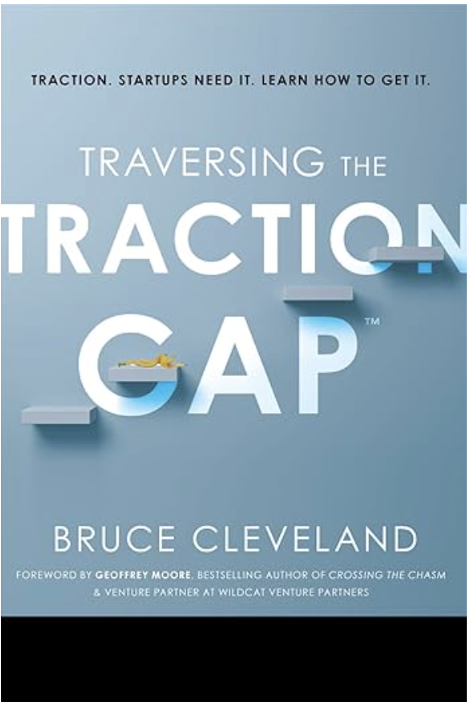
Traversing the Traction Gap
The Bestselling Guide to Building Market Leaders
Written by Bruce Cleveland, this book transforms decades of real operator experience into an actionable system.
The Traction Gap Framework
A stepwise, milestone-driven operating system for scaling B2B companies from idea to market leadership. The framework defines clear "value inflection points" with explicit criteria and deliverables at each stage.
Critical
Milestones
Explained
Minimum Viable Category (MVC)
Define your market category before building—the foundation for future positioning.
Initial Product Release (IPR)
First user-facing version—measuring feedback and stage readiness.
Minimum Viable Product (MVP)
Prove market demand through willingness to buy and use.
Minimum Viable Repeatability (MVR)
Systematic customer acquisition—the signal you're ready to scale.
Minimum Viable Traction (MVT)
Consistent demand that unlocks funding and expansion.
Four Pillars of Scalable Growth
The Traction Gap Framework ensures all four pillars evolve together, aligned to each value inflection point.
A master of category creation and market engineering
Pablo Corica
CEO & Cofounder, Critical Streams
Transform Your Market Strategy
About the Author
Bruce Cleveland is the founder and CEO of Traction Gap Partners and author of Traversing the Traction Gap and new book titled, Market Engineering: Because Markets Don't Engineer Themselves.
He created the Traction Gap Framework from 30+ years of operating and investing experience—watching startups and mature companies fail despite great products and building systems to help them succeed. The framework has since been adopted by universities, accelerators, and venture firms worldwide as the standard for evaluating market progress and potential.
